


Why doesn't a lawn tractor battery survive the winter? 7 most common user mistakes
Many lawn tractor owners have encountered a similar situation. In autumn, the machine was parked in the garage, everything worked flawlessly, but after a few months of winter storage, the engine refuses to start. First thought? The battery has failed. However, the battery itself is not always to blame. In the vast majority of cases, the problem arises from improper winter storage preparation....
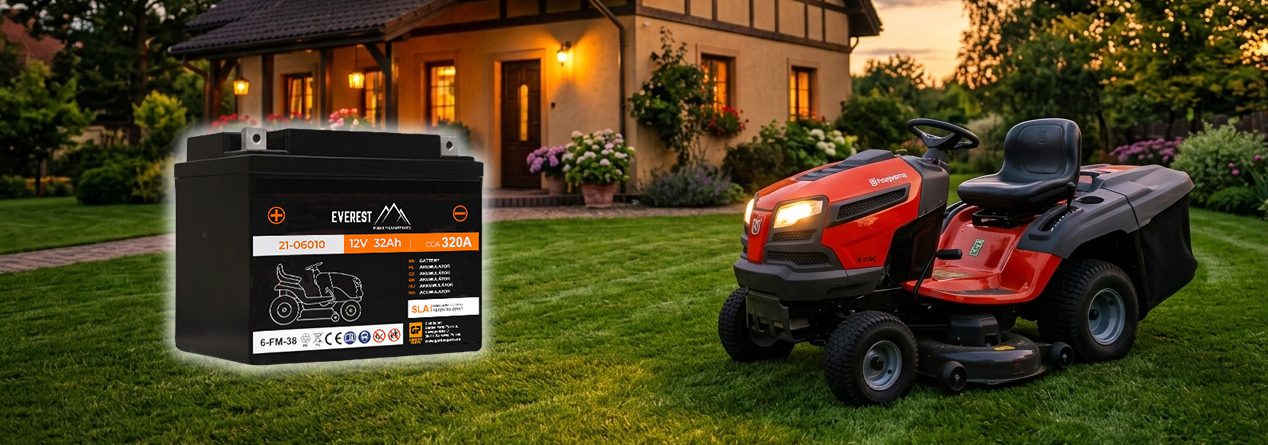
Many lawn tractor owners have faced a similar situation. In autumn, the machine was parked in the garage, everything worked without fault, but after a few months of winter idle, the engine will not start. First thought? The battery broke down.
However, the battery itself is not always to blame. In the vast majority of cases, the issue results from improper winter storage preparation. Even a high-quality AGM battery can be damaged if left discharged for several months or stored under unsuitable conditions.
Check which common mistakes shorten the lifespan of lawn tractor batteries.
1. Leaving a discharged battery for the entire winter
This is by far the most frequent cause of problems.
At the end of the season, many users park the tractor in the garage without paying attention to the battery's state of charge. Meanwhile, every battery undergoes natural self-discharge. This means that even when the machine is unused, voltage gradually drops.
If the charge level remains too low for an extended period, plate sulfation begins to occur inside the battery. Lead sulphate crystals form on their surface, impeding subsequent recharging.
The result?
- gradually decreasing capacity,
- reduced cranking current,
- difficulty starting the engine,
- the need to replace the battery despite its low age.
Therefore, before winter it is always advisable to fully charge the battery.
2. Failing to recharge during winter storage
Simply charging the battery in autumn is not always sufficient.
If the machine sits idle for four or five months, the energy level will steadily decrease. It is advisable to check voltage every 4–8 weeks and recharge the battery with an appropriate charger if needed.
Modern automatic smart chargers can maintain the correct charge level without risk of overcharging, keeping the battery ready for action all winter.
Regular recharging is particularly crucial for machines used exclusively on a seasonal basis.
3. Storing the tractor in an unheated room

Low temperature in itself does not destroy a healthy battery.
The problem arises when the battery is partially discharged. The lower the energy level, the more susceptible it becomes to freezing temperatures.
Furthermore, low temperatures decrease the battery's ability to deliver cranking current. Even if no damage occurred, starting the engine can be considerably harder.
If possible, store the battery in a dry place with temperatures above freezing. If it remains in the tractor, be sure to recharge it regularly.
4. Deep discharge shortens battery life
Every battery has a specific number of duty cycles.
One of the greatest hazards is its complete discharge and remaining in such state for an extended period.
In practice, this means that even a relatively new battery can lose a significant portion of its capacity after just one winter.
If at the end of the season you notice the starter motor turns the engine sluggishly, do not postpone charging.
5. Terminal corrosion and poor electrical connections
Not every starting problem indicates a damaged battery.
Very often, dirty or corroded terminals are to blame.
A coating of corrosion increases electrical resistance, so the starter motor receives less power than required. Symptoms may look identical to a discharged battery.
Before the season begins, it is advisable to:
- clean the terminals,
- check terminal cable tightness,
- remove any corrosion,
- protect the contacts with an appropriate grease or protectant.
This is a few minutes of work that often avoids unnecessary battery replacement.
6. Inappropriate charger
Not every charger is suitable for every battery type.
Modern AGM batteries require chargers that monitor charging voltage and automatically terminate the process once full charge is achieved.
Old chargers without electronic regulation can overcharge the battery, negatively impacting its durability.
If your tractor is equipped with an AGM battery, it is worth using a charger specifically designed for this technology.
7. Purchasing a battery incompatible with the machine
Not every 12V battery will be suitable.
When purchasing, pay attention to:
- capacity (Ah),
- cranking current,
- dimensions,
- terminal polarity,
- manufacturing technology.
An incorrectly selected battery may cause starting issues, and in extreme cases might not even fit the mounting tray.
Therefore, it is always worth checking manufacturer recommendations or choosing a model that matches original specifications.
How to prepare the battery for winter?
If you want the battery to start the tractor effortlessly at the start of next season, perform a few simple steps before putting the machine away.
- Charge the battery
- It is best to do this immediately after finishing the last garden tasks.
- Clean the terminals
- Remove dirt and traces of corrosion. Clean contacts ensure better electrical conductivity.
- Store in a dry place
- Moisture accelerates corrosion of electrical components.
- Monitor voltage
- Every few weeks, check the charge level and recharge the battery if necessary.
- Do not wait until spring
Most damage occurs precisely during months of idle storage. A few minutes invested during winter can extend battery life by several seasons.
Does an AGM battery handle winter better?
Increasingly, garden machinery manufacturers use AGM technology batteries. Their sealed, maintenance-free design and superior vibration resistance make them exceptionally well-suited for seasonal equipment.
However, this does not mean they are entirely immune to neglect. Even the best AGM battery left in a deeply discharged state will gradually lose its properties.
Therefore, regardless of the technology used, proper preparation of the battery for winter storage remains paramount.
Summary
Most battery problems in lawn tractors do not stem from product defects, but from improper off-season maintenance. Leaving a discharged battery, failing to periodically recharge it, or storing it in unsuitable conditions significantly shortens its service life.
If you invest fifteen minutes into properly preparing your battery before winter, there is a strong likelihood that the tractor will start smoothly in spring and the battery will last for many seasons to come.